Inventory
$1,650,000
1951 Porsche
356 Sauter Roadster
1 of 1 constructed, first Porsche Roadster, and first 1500 to race. Among the most Historic Porsche racing cars in existence.
- VIN10359
- Exterior ColorSilver
- Interior ColorRed leather
- Mileage5314 Kilometers (TMU)
- Engine1500cc flat 4-cylinder
- Engine no.30244
- Transmission4-speed manual
- StatusInventory
- StockFJ3083
Description
1951 Porsche 356 Sauter Roadster
VIN – 10359
Engine No. - 30244
Exterior Color – Fish Scale Silver
Interior Color – Red
Engine – 1,500 cc air cooled 4-cylinder
Gearbox – 4 speed manual
Coachwork – Hans Klenk Karosserie
Current Kilometers – 5,314 TMU
Highlights
One of a kind hand built roadster with numerous racing victories
Period racing history including Nürburgring, Hockenheim, and Spa Francorchamps
Lightweight, lowered, hand formed steel body with rear opening doors
Concours quality restoration by Porsche specialists
History and Construction of the Sauter Porsche
As a world leader in performance car construction, Porsche has earned legions of dedicated worldwide enthusiasts driven by their passion for design and engineering excellence. Porsche’s legendary engineering was instrumental in building their brand into a motorsports and production car leader. By the early 1950’s Porsche cars were making their first public appearances at race venues with their newest offering, the 356, drawing notable attention in European motorsports journals.
In October 1950, American entrepreneur and businessman Max Hoffman, met with Porsche to discuss North American import plans encouraging construction of a roadster. As many Porsche enthusiasts know, Hoffman was key to Porsche market expansion in the rapidly growing North American market. But in 1950, lacking internal resources to complete roadster construction, Porsche put these plans on hold. As part of the Hoffman/Porsche meeting, drawings were penned by Edwin Komenda (356.00.320) depicting a roadster based on the 356 platform. Concurrent with the Porsche/Hoffman meeting, industrialist Heinrich Sauter, a Stuttgart based businessman, former Luftwaffe fighter pilot, and heir to an industrial equipment family fortune, committed his resources towards a similar project. Sauter had successfully raced a steel body 356 Coupe but was seeking a lighter, lower profile, open car that could achieve higher top speeds. Leveraging his connections with Porsche and his credibility as a proven racer, Sauter purchased chassis #10359 from Porsche and commissioned the fabrication of a roadster body interpreted from the drawings penned by Erwin Komenda. Sauter, flush with family resources, proceeded with the construction of his roadster – one that would ultimately inspire Porsche and become a template for future 356 roadsters.
Porsche supplied an early series Pre-A 356, #10359, which Sauter arranged for delivery to Hans Klenk Karosserie. Klenk, the proprietor of this coachbuilder shop just outside of Stuttgart, was well regarded in racing circles. Known for their work with Mercedes Benz race cars, Klenk had gained fame as a co-driver of the winning Mercedes-Benz. 300 SL raced in the 1952 Carrera Panamericana, the same car that struck a buzzard with Klenk at the wheel, eviscerating the windshield and exiting the rear window. Unflinchingly, Klenk pitted some miles later where the car was fitted with the now famed “Buzzard Bars” as it went on to win the race. With the Sauter 356 now delivered to Klenk, the standard 356 body was removed, and a hand formed steel roadster body was lowered 3 inches when fitted to the 356 platform. These changes not only improved aerodynamics and handling, they reduced weight and gave the car a unique visual signature reflective of the original Komenda drawings, though lower in profile and without Sauter’s unique rear-hinging doors. The final design was quite advanced including several innovative features:
- Lightweight construction estimated at less than 1,600 lbs.
- Rear hinged doors to facilitate quick entry for Le Mans starts
- Louvered hood vents for heat dissipation
- Streamlined fender design, no bumpers or chrome
- Purposeful interior omitting non-essential items to maximize performance
#10359 was completed in six months and prepared for the first race, the Eifelrennen on the Nürburgring in Spring 1951. Listed as a VW special, the Sauter 356 Roadster was an unknown entity, so Porsche encouraged Sauter to not enter the car under their name, thus suggesting the entry as a “VW Special” rather than a Porsche. However, after leading the first lap and completing the second fastest qualifying lap on the first outing, Porsche realized their good fortune and asked Sauter to change the entry name and announce the car as a Porsche. Though the car was not able to finish the race, it was considered a success by all accounts with Sauter far in the lead after the first lap but retiring later with engine failure. This race would mark the second appearance of a Porsche roadster as a registered race car for a competition event.
Sauter went on to race #10359 in the Freiburg-Schauinsland Hillclimb, the Liege-Rome-Liege Rallye, and the car was also tested in practice heats around Stuttgart, practices at Solitude and other venues, where early mechanical issues were resolved including improvement to the steering alignment, attributed to the changed design allowing for rear hinged doors. After these races and tests, the car was purchased back by Pursche in late 1951, returning to the factory works. Sauter went on to race notably in the 1954 Mille Miglia to a GT class win with Richard von Frankenberg driving a 356 Coupe, eventually retiring from racing in 1955, but the story of his commissioned Porsche roadster continued on once again with Porsche.
Having been taken in at Porsche, in 1952 the Sauter 356 Roadster was updated by Porsche as an internal factory project. Though it was formerly raced and under prior ownership to Sauter, Porsche factory records including the factory Kardex confirm the Sauter 356 Roadster was processed by Porsche with the same chassis and engine, based on the factory Kardex, and chassis tag. Outfitted with the 1,300 cc engine, Porsche had specially modified the Type 528 engine and prepared it to 1,500 cc using a roller crankshaft, twin carburetors, and a reportedly hotted cam specified by Sauter. Additionally, the factory added front brake cooling vents under the headlights. Sauter is documented stating the car was fitted with a factory 1,500 cc engine and was raced extensively by Francois Picard, Nice, France, a local French hero and friend of Sauter who acquired the car from Porsche. This is also confirmed by Picard’s name noted in handwritten script on the Porsche Kardex. Cleverly, as anti-German sentiment was still strong in France, Picard became a hero to the French winning the 1950 Tour de France with another car that had been fitted with Sauter’s former 356 Coupe engine, bolstering Porsche’s reputation in France.
Under Picard’s ownership, the Sauter 356 Roadster was painted blue and was entered in multiple European races in Germany and France, where it became affectionately known as “The Little Tank” earning six class wins in 1,500cc categories including 1952 12 Hours of Hyers, Bordeaux Road Race, Val De Cuech Hillclimb, a Third in Class at Solitude, First in Class at Hockenheim’s Spring Event, competitive runs at Spa-Francorchamps rallies battling a sticky carburetor while competing in wet conditions, and participation at the Grand Prix Monaco, DNF. Though participation at the 1952 Mille Miglia resulted in a DNF due to an overheated engine, and clutch failure sidelined the car at Nürburgring, the Sauter 356 was, by all accounts, both a design and performance success considering the pioneering aspects of the 1,500 cc engine, roadster configuration, and early history as a 356 racer.
And while the Sauter Roadster origins were singular, internal Porsche roadster development was taking shape with production in mind. Sauter and his roadster had impressed Porsche enough to consider Hoffman’s insistence to build and campaign roadsters of their own. Porsche’s internal effort would result initially in the “American Roadster” which utilized aluminum bodies constructed by Heuer-Glaser in Weiden contracted to build cars (16 built, 9 remaining) using the 528 1,500 cc engine, including one roadster which was built based on drawing 540-00-202 using the lowered belt line of the proven Sauter/Komenda configuration. The Sauter 356 Roadster would inspire the American Roadsters which would ultimately race under the Porsche name until the 550 Spyder and eventual Speedster would establish Porsche as a leader in both road and racing variations of coupe and roadster production.
Returning to the history of the Sauter Roadster, as European racing concluded in late 1952, #10359 had, after Picard’s racing efforts, returned to Porsche once again where it was stored at Works 1, Stuttgart until early 1953 when the car was purchased by attorney Sam Mullin, a prominent advocate and participant in the growing California sports car racing scene. The car was then shipped to California and prepared for California road racing events. Mullin competed in sanctioned North American races throughout 1953 including appearances at Riverside, Moffett Field, Santa Barbara, Bakersfield, March Field, and the 1954 Pebble Beach race where it logged a DNF. Remarkably, though the rigors of racing had taken a toll, the car survived, remaining for decades, largely hidden from view under private ownership spanning 1954-1982. Despite deterioration, the long-term owner recognized the importance and rarity of the Sauter 356 Roadster. In 1982, historian and Porsche expert Ray Knight discovered the car, approached the owner, negotiated his purchase, and painstakingly restored it to a very high standard over several years. During this time, Knight amassed interviews from people involved with the car, researched the history and relevant overlap to the Porsche works projects, and compiled extensive documentation including racing listings, period photos, and historic accounts from Sauter himself. In 2018, The Petersen Automobile Museum featured the car in the “Porsche Effect” exhibit in the Mullin Grand Salon in the company of other significant Porsches including the Type 64 and a 1956 550 Spyder. Under current ownership the Sauter 356 Roadster has been maintained as part of an extensive vintage performance car collection.
Given that the Sauter 356 Roadster was well ahead of the earliest Porsche factory roadsters, #10359 is today regarded as one of the first 1,500 cc Porsches to race, the second Porsche 356 roadster to race under the Porsche name, and remains one of the most important early 356 roadsters conceived and constructed. Credited with ultimately influencing the success of the emerging Porsche production roadster and Speedster designs and ultimately changing the course of Porsche history, the Sauter 356 Roadster holds a unique and documented historically important place as one of the most desirable and earliest Porsche 356s ever built.
With racing history, documentation, and Porsche Kardex, the Sauter 356 Roadster is eligible for participation in virtually any premier classic race or concours event throughout the world and is sure to delight the most fervent and selective classic Porsche enthusiast, collector, and admirer of pioneering motorsports excellence.
Current Presentation
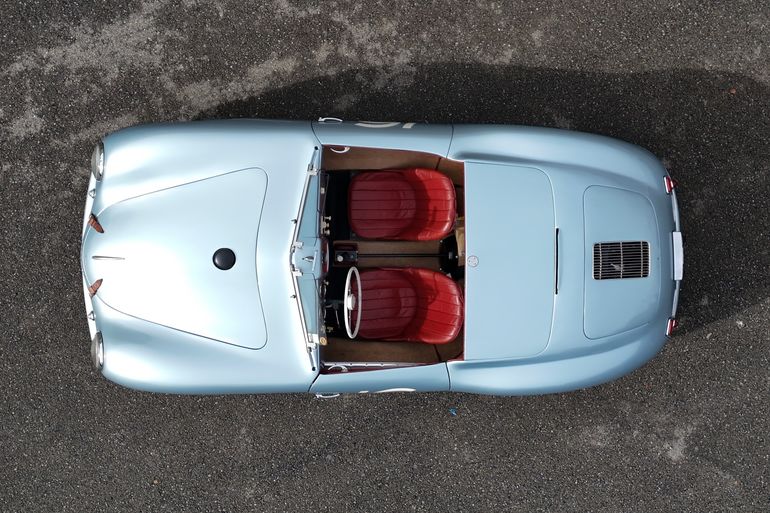
Today this one of a kind Porsche 356 Sauter Roadster presents beautifully with a refined and painstakingly accurate restoration reflecting the original Porsche factory history, racing lineage, fortuitous discovery, and detailed restoration after decades hidden from public view. #10359 is finished in the correct microflake “fish scale” silver metallic color which was matched from paint sections found on the original underside body panels. The finish is smooth and glossy on all body panels. The unique rear-hinging doors, hood, and trunk open and shut smoothly, exhibiting excellent fit, remarkably so considering the handmade one-off construction of the all-steel body. With minimal trim and lightweight body colored bumpers, the 3” lowered body sits perfectly over all four wheels. The low slung roadster design delivers a captivating, purposeful, and sporting stance, while retaining the family features of the original 356 Porsche design.
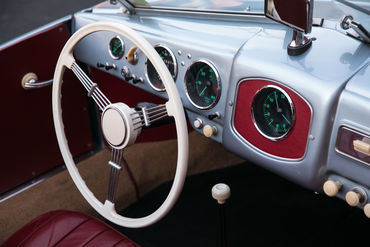
The interior is also remarkably accurate and historically unique given the roadster configuration. Crisply detailed components display continuity of materials and finishes in every area. The red leather has relaxed perfectly to convey the sporting refinement of this early series 356. The seats and door panels are accurately tailored from years of research, accented by delicate touches of chrome trim on the early dashboard design. The painted dashboard features precisely restored instruments showing vivid color and clarity along with correct switches and knobs. Of note, the dual windscreens and blended rear cowl are the perfect pairing for this low profile roadster The front storage area houses a fuel tank fitted with a through hole for the fuel filler, leather bonnet buckles, and inside, a correct factory serial number stamped in the proper location along with a Porsche manufacturing plate bearing the chassis and engine number.
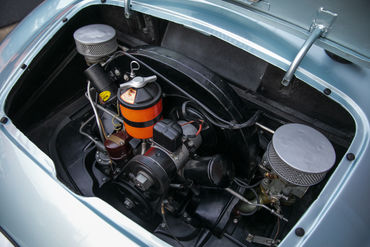
The engine and engine bay are beautifully detailed and finished to a very high level. The engine is outfitted with twin carburetors just as it was in preparation for racing as a pioneer of the larger displacement configuration. The engine compartment presentation is very accurate with correct air cleaners, correct finishes, proper coatings, and careful attention to factory correct details which have been researched by the restoring owner supported by a cadre of professional Porsche experts. The underside of the car is sound and faithfully restored, retaining as much of the original components as possible in support of this truly remarkable and special 356 roadster.
Documented since construction in 1951 with period racing history, this Porsche 356 is among the most significant privately held 356 Roadsters available today. Considered by Porsche historians to be the second Porsche roadster constructed (the first being the Porsche #1 factory car) and the first to compete with the 1,500 cc engine, this historically important Porsche is ready for any premier showcase, touring event, or Porsche concours.
Please note: Information shared here is based on research gathered by prior owners, current historians, and Porsche documentation. We recommend buyers engage in a PPI and perform their own research to verify information shared here with their expert sources.
The above vehicle information is complete and accurate to the best of our knowledge at the time it is posted to this website. Corrections or additional information is always appreciated. All advertised prices exclude government fees and taxes, any finance charges, any dealer document preparation charge, and any emission testing charge. Vehicles are subject to prior sale. All advertised to be true but not guaranteed. We assume no liability for errors or omissions.
Inquire About This Car
Fantasy Junction • 510-653-7555 • 1145 Park Ave, Emeryville, CA 94608
Similar Cars
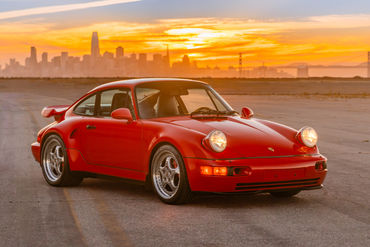
1994
POA
Porsche
964 Turbo S 3.6 Flachbau
Among the rarest and most desirable air-cooled 911 variants; 1 of just 39 produced for the US Market and 1 of just 93...
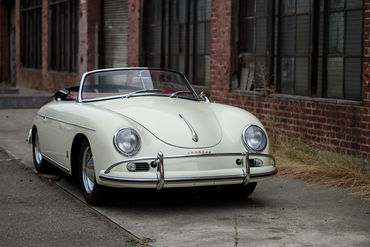
1959
POA
Porsche
356A Convertible D
Bring A Trailer auction preview: Beautiful restoration awarded 1st in Class 2023 Niello Concours.